Sunday, September 16, 2012

8/27/12 -- The week of Maquipucuna, part of a story of failed blogging.


Jackclyn, are you serious? You said you were keeping a blog and then you disappeared for three weeks. What in the world have you been doing?!
Well, the last time I updated was three Sundays ago and I have since then been to the Maquipucuna Reserve cloud forest, to Tiputini Biodiversity Station, and to final projects and exam land with my Tropical Ecology class. I will probably not have enough pictures to satisfy curious minds, and I apologize for that. Once I get my classmates’ high-res pictures of the cool things we saw, I will have them up. 

As a quick recap of the first week I missed: I successfully registered my student visa with the Ecuadorian government, we had some really cool class lectures about cloud forests and tropical rain forests, and Maquipucuna was beautiful.

More detailed: 

Monday I went with Kari and Savannah back to Quito to get our visas. There was no hiccup and we got back in time for pastries (Croissant nutelas at the school bakery para morirse!) and studying. Tuesday seems to have been unremarkable. Wednesday, Chelsea and I went on a bus adventure to the edge of Quito for an outdoor store called Tatoo, which is the Ecuadorian equivalent to REI, except their store brand clothing is much more affordable. I purchased my first pair of hiking pants (very useful things, they are! Durable, light, quick-drying, and protective!) and wandered the store as Chelsea climbed on their rock wall for fun. 
Thursday we left at 8 am from USFQ for our 2-hour bus ride to Maquipucuna Nature Reserve, which is in a cloud forest or montane forest ecosystem. 
This journey involved the entire class’s discovery of the joys of Kiwa All-Natural Vegetable Chips (a company run by none other than my host sister Natalie and her husband!) and some complications with motion sickness for a few of my classmates, but all in all, I think we did well in transit. I have no pictures from the bus, so this chip bag shall suffice. 
A cloud forest is at just the right altitude between the lower and upper alpine latitudes that a unique band of specific vegetation and life forms thrive at just about the cloud level in the atmosphere. 
To illustrate how closeby Mindo and Maquipucuna are to each other (just a turn off the main road and a few windy paths down the mountain away!), here is a picture of the stream right by our cabins in Maquipucuna. 

I had to look back at pictures to make sure I didn’t repeat my Mindo hostel stream picture. Maquipucuna is by a much larger and faster stream. 
Mindo has a slow trickle. In the distance a few minutes after I took this picture, some people came by to do their laundry in the water. MOSQUITOES GALORE. 

The path to our Maquipucuna cabins and - most importantly - the eating area. 
At the eating area, our first lunch awaited us. I’m not entirely sure what is in this red chicken sauce, but it is really delicious. The yellow patch is a type of banana that has the exact same taste as dry potatoes. The drink, covered by a napkin to keep out curious wasps, is some sort of sweet tea. Hummingbirds kept us company at the feeders around the dining tables. 

This first day, the class was split into 3 groups to conduct “field work” with either Esteban, Carlos (one of the reserve’s resident naturalists), or by themselves. The 3 groups were responsible for taking data about the forests’ tree properties (canopy coverage, tree density, canopy height), soil properties, or life forms. I was in the tree property group, and Carlos was our guide. He is really cool! I know because I spent most of our walking time chatting with him and asking him my and others’ questions about the forest and its plants and animals. I was somehow designated translator for the group today.

Succession is the process undergone by an ecosystem as organisms colonize it. The two types of succession are primary and secondary. For a quick ecology lesson on succession, please view this short video: 
That shows the basics of primary succession, which occurs where there isn't existing soil. Secondary succession usually happens after a large disturbance to the ecosystem that still leaves most of the soil intact, such as a fire, cattle grazing, or flood. The idea is that each form of succession brings with it different plant forms. A little more information is on this web page by Penn State
Note: there is a school of thought that wants people to rethink the very cut-and-dry way of considering succession. Especially when it applies to more diverse ecosystems that aren't temperate forests, it is not really possible to predict what species will take up residence in a ecosystem that has opportunity for colonization. 

During our field work, we confirmed that secondary forests have lower canopy heights, more trees that are a similar species with thin trunks, and less canopy coverage than primary forest overall. I was meticulously writing data and chatting with Carlos and thus did not take pictures during this portion of our trip. But here are pictures from Google that kind of show the differences between these two types of forests in the montane ecosystem. 
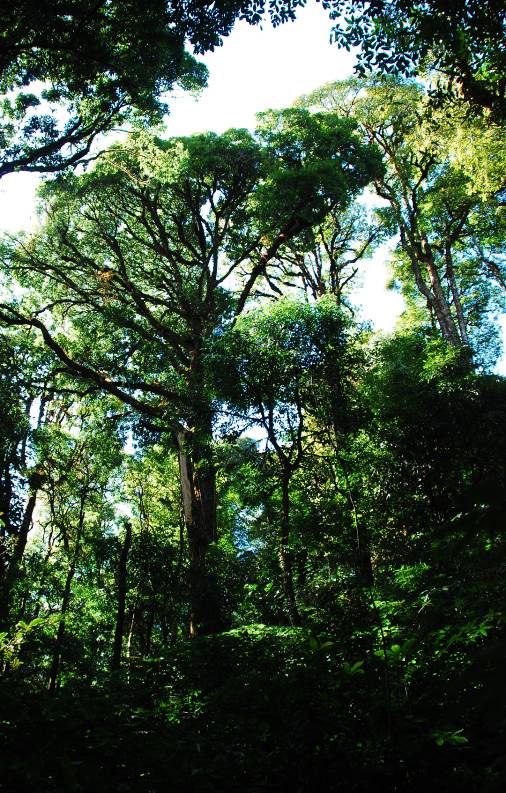
The primary forest was much darker due to higher canopy coverage, with larger and more majestic trees.

Secondary forest with wimpy skinny trees. They seem tall, but they actually were not when compared with the primary forest trees.
The disturbance in the area around Maquipucuna was the act of grazing by subsistence farmers’ cattle. Now, the area is kept by 11 farmers of cocoa and coffee who work with the reserve and live harmoniously with the land. 

Picture I've pirated from Nick (more of his work very shortly!) featuring our group sans photographer trying to figure out how to measure forest properties in the secondary forest part of the hike.
We returned from our hike, prepared a snappy skit (complete with a Call Me Maybe spoof with dance moves) to present our data, presented data with the other groups, ate a nice dinner of spaghetti and meat sauce with a tub of cheese in the middle of the tables, and played Telephone Pictionary until it was time for bed. Which was about 10:00 pm, since we were to wake by 6:15 am the next morning for an “optional” birdwatching journey in the trails. I wasn’t going to miss out. 

Our nature guides and professors have an incredible ability to spot animals from impossible distances and unlikely angles at all points on a trail. They also have really powerful telescopes that do not match the puniness of our binoculars. I’m not sure how many types of birds we saw that morning, but it was over 2 dozen and I was happy to have gotten this picture through the eye of one of their strong telescopes. 

At one point there were 5 birds perched on this tree, but two of them flew away by the time I was able to focus the iPhone camera (I take pictures on my iPhone. It’s fine.). Can you spot them? The other class, which traveled with us to Maquipucuna, had a bird cataloguing assignment, so they are more likely to know the species and names of these birds than I am. Their class and also Kari, who loves birds. 

We returned to have breakfast - by the way, fresh warm Ecuadorian sweet breakfast bread is comparable to fresh warm Chinese sweet bread, and that’s saying a lot - and then set off on a hike deep through the mountain and to a waterfall. 
We started through this field, where we could see the expanse of what was ahead of us. 

After the field, we came across an enormous snail (caracola in Spanish, which also translates as "face tail" hehe!) greeting us to the treacherous forest, and Nick put his hand by it for comparison. Savannah’s water bottle is also featured. Caracola had moved about a foot further when we came back 5 hours later. 


We hiked through the mountain on steep and winding trails cut through the earth by soldiers of the Incan empire, and well traveled in the later 1800s by illegal liquor traders.  I don’t know how people managed to transport cargo through those trails, because I sure had a hard enough time just staying upright with a bookbag on my back! This picture doesn't depict the very steep dusty slopes that we conquered. 

There were scenic waterscapes. 

And I thought enough to take a picture with a leaf of my favorite plant in the ecosystem - the cecropia tree. 
Me with a cecropia leaf.
The cecropia tree is one of the pioneer species of many mountain ecosystems. Whenever there is a new plot of land to be conquered or somewhere that had a disturbance that wiped out its old tree growth, cecropia trees willingly take on the challenge. They reach maximum height relatively quickly, but they are also expending so much energy to grow tall that they have sacrificed strength in their wood and chemical defenses in their leaves. As a result, they surrender to infestations by bugs and other plants and fall to make room for secondary succession plants at a young age of about 35 years. The wood is a similar lightness to balsa wood, which is also a pioneer species tree. One of my favorite features of it are the humongous leaves it holds up, and how small I felt standing amidst hundreds of fallen leaves on the forest floor. 

Also please note: IT IS A TREESTAR. 
This is still me with a cecropia leaf. 
Since I don’t have waterproof visual equipment, I don’t have any pictures of our arrival, wading, and plunge into the stream by the waterfall. The water was extremely cold and there was a giant rock under the waterfall that people used as a slide (parents, no I didn’t participate because it looked like it hurt. Also the water is freezing.). 

After a quick dip and some pictures in the water, we hiked back warped speed - I figured out that trotting down a steep and dusty slope instead of trying to gingerly balance works a lot better - and had a marvelous lunch of fresh fried tilapia (there is a farm about 10 minutes outside of the reserve), rice, onion salad, and soup. After that we cleaned up ourselves and our cabins and left for Cumbaya. 

Saturday was the International Students Welcome Party, which I had paid for but sold my spot to Ian because my independent research paper was still needing some edits. So I woke up at 7 to have breakfast with Savannah before she left for the day-long affair, and I stayed in Cumbaya to tidy up some charts, figures, and research write-ups. 

In the process, I had a tamale and an empanada at an ice cream shop. They were very tasty, and the shop had good ahí (Ecuadorian hot sauce, which is the only spicy thing they have in their cuisine). 

 I then strolled to El Español, an upscale 2-story cafe that sells fancy chocolate, cheese, nuts, and wine and has wifi. I went because of the wifi and partook also in a frozen coffee-less Twix drink. Savannah returned for dinner and I kept working afterward.
Maybe I secretly want to be keeping a food blog?
Sunday, Savannah, Chelsea, Joe (someone they met at Saturday’s day party) and I went to a rock climbing wall. Savannah taught me how to boulder, I made it halfway up one of the climbing routes (my arms just could not handle any more after I’d bouldered for a while), and I played around on the slackline. We, sans Joe, then took the bus to the Quito artisan market aka the perfect place for souvenirs and came back in time for Chelsea to land a free dinner with our host mom and a ride with Jose Antonio back home since the taxi companies weren’t answering Natacha’s call. 
We packed for Tiputini and went to bed, not sure of the adventure ahead. 

And tonight (September 16) I head to bed also, because I have the adventure of my first day of Mountain Geology class tomorrow. I must face this before I update you on the rain forest. There are lots of pictures from the rain forest, and I'm not yet sure how to share them without creating an overwhelming entry.

Pues.... 
Buenas noches, y hasta mañana! 

Sunday, August 26, 2012

From Paluguillo to Minnie Mouse


My ankle performed wonderfully during our hike. My lungs, however, were trying their best but were not as up to par as my limbs. And afterward we were rewarded with an hour at a hot spring pool, which has water kept warm geothermally since the mountains are volcanic. 
Here are some pictures from our hike of Paluguillo. I'm a terrible photographer. 
View on the way to the top of Paluguillo 
This is my professor, Esteban, pausing on one of our many stops along the hike to point out natural features - in this case, the cushion plant next to him and the relative warmth of its decomposing inside. The lower on mountain, the fewer cushion plants you will see. 

Icy, muddy conditions ain't no thang for these highly adapted plants. Not highly adapted humans though. 

These plants are related to the plants most common in dinosaur times. 

We had some pretty wonderful views during our hike. This is solidly located in the grassy páramo ecosystem, note the tussock grasses abundance. 

Look what a tiny trickle through a field can turn into! 

This is part of a giant rosette. Note the tiny blue flowers inside of the protective hair-like fibers. 


Esteban explains his backup career plan, and we give it a try. 

And then we had Thursday and Friday off from school. Conveniently, my Certificado de Visación - which I’d stupidly left in the scanner back in Charlotte - came in the mail that morning and I was able to get everything together to register my visa in Quito with Kari and Savannah. We ate at KFC 
Yes I know. I don't even go there when I'm in the US, but Natacha recommended we eat there because it's clean, and I ordered the most Ecuadorian thing on the menu; it was called the "Supercombo 2" 
Then we made our way onto the bus to Mindo. 
On the bus, I heard and enjoyed this song: 


Notable things we did in Mindo (for better and more pictures, please visit Savannah’s post) : 

Made friends with Kurt from San Francisco and Ari from London at our hostel the night we arrived and decided to hang out with them the following day. 

Had breakfast with them. 

This is cafe con leche, scrambled eggs (completely cooked, parents stop freaking out.), a roll with butter and jam, and naranjilla juice, which is an orange-esque fruit native to the Quito area. 


This was the view from the breakfast area of the hostel. 

Went to the Mariposario, aka butterfly garden, made friends with them and saw their incredible adaptations. 
Me making butterfly friends. This fellow suffered some sort of wing injury but was doing alright in the conservatory. 
Cocoons are pretty awesome. I especially admire the ones on the bottom few rows that look like dead leaves. And note the ones that are shiny - they are imitating water droplets and belong to butterflies that hatch near bodies of water.  
Another butterfly friend I made

Went to Mindo Lindo, which is a short taxi ride to a cloud forest nature conservatory with lots of hummingbirds and tons of cool flora. 
One of the hummingbirds at Mindo Lindo. My favorite one was the booted racket-tail, which I didn't get on camera. 

Can you see the bright blue beetle? 

Pretty cool flower.

Ate lunch. My meal had the word “criollo” in it, but that’s all I remember. 

At some point walked by a restaurant that serves drinks and snacks at a bamboo shack to customers as they sit on swings, and heard this song. It sounded vaguely Chinese and immediately caught my ear. 


Got up super early to catch the bus back on Saturday to make it to Milena’s extravagant 2nd birthday party with her parents’ family and friends, but also to nap and read 9 research papers for class. 

The lady on the near right is Natacha, my host mom. Yes that is a blow-up slide. Yes, there are people setting up a cotton candy stand and getting ready to have the Mickey and Minnie Mouse costumes filled. 
Everything was Minnie Mouse themed, with 4 varieties of desserts. This is the tennis court in the neighborhood park.  
Yes, the several households involved in this event had their hired help cater the event. There were sausage sanduches and lots of sodas. 

Milena's 2nd birthday, sponsored by Kiwa all natural Andean vegetable chips - her parents' company. And a total of 104 pink sprinkled cupcakes, made by her grandma Natacha. 

Milena after posing for several pictures. 

So I have quite a bit of work this week, and we have another field trip either on Wednesday or Thursday to a montane cloud forest to study biodiversity. I don't think I will be updating very much these few days, but bear with me and know that I am safe and getting stuff done. 

Tuesday, August 21, 2012

Sunday through Tuesday


PICTURES TO COME SOON
So I’ve definitely slipped from my attempt to update every day here. Shortened version of what I’ve done the past few days: 

Sunday, aka “Just get on the green bus, they said. All green buses lead to Quito, they said. It’ll be 25 cents, they said.” 
Savannah and I knew we wanted to go explore Quito, so Claudia and Antonio recommended that we visit Plaza Foch and the Telefériqo, so after taking some directions and tips, we went on a bus adventure. 
And by bus adventure, I mean Savannah and I took the green bus to the end of the line in the wrong direction (FYI, it goes to Puembo, which is a poor shanty town) and then hopped on the next one going the opposite direction to finally make it to Quito.
Arriving at the Rio Coca bus station extremely hungry, we decide to each have an empanada from a vendor set up near the ticket stations before taking the Ecovía to the intersection of Manuela Cañisteras and 6 de Diciembre to get to Plaza Foch. Turns out it is a direct stop in tourist trapland. Savannah had a cup of coffee from The Magic Bean, which apparently did not have magic in their beans, and then we took a taxi to Telefériqo. 

Telefériqo was incredible. I’m constantly shocked at how thin the air is at higher altitudes and how noticeable it is in my lungs but other than that and the chill up there, the view was fantastic. I refer you to Savannah’s page for some good images of our experience. We could see all of the mountain ranges in the cordillera around town, especially Cotopaxi, which I will climb in Mountain Geology class in a few weeks. Pretty gorgeous. 

Then we took the Teleférico shuttle back to an Ecovía station and rode back to Rio Coca, hopped on a green bus the correct way, and finally got back to Cumbaya in time for a nice dinner of rice, beans, and chicken. At some point in the evening, I heard my computer charger make a snapping sound in the converter box area and realized it stopped working. It was great. 

We watched the animated movie “TinTin” with host mom, host dad, and Antonio, and then went to sleep. 


Monday: CLASS STARTS! 
The first day of Tropical Ecology was really nice. We did some introduction and course explanation, syllabus-type stuff, and proceeded to review basics of ecological concepts. We were split into 5 groups to for an independent research project, which we are to present at the end of the course in 3 weeks. Our professor Esteban Suarez kept emphasizing how important field work is to learning ecology and that by first learning the facts and patterns of the systems and then seeing them in real life and interacting with them directly, we are genuinely learning in a living laboratory. This week we are hiking down Paluguillo to see the páramo wet alpine ecosystem, next week we’re exploring a cloud forest, and the week after that we will be going to the Amazon to spend several days at the Tiputini Biodiversity Station. Biology at its purest. 

Unfortunately, I felt rather ill the entire 3 hours we spent in class this morning. After class we had lunch and I tried to buy a computer charger. It was really expensive, so I didn’t buy it at that point. So instead I went back to the house for water and a nap to nurse my tumultuous stomach.
About 2:30, I went back to campus to take a Spanish placement test for the voluntary supplemental language class we’re offered in the afternoons. So it was my luck that I twisted my ankle stepping from a ramp just outside of the classroom. Fortunately, some classmates were coming from the room and were able to help me up. I’m told I entered the classroom a much paler color than my normal complexion. 

I was pretty sick the rest of the day, but after several hours of sleep with some Pepto Bismol and Motrin, I woke up feeling infinitely better, did my class reading, and prepared for class the next day. 


Tuesday: Páramos are really awesome and really sad at the same time 
We discussed altitudinal zonation features of páramo ecosystems. Páramo are wet alpine ecosystems, located in the northern Andes (where we are!), some in Africa, and some very sparsely in Indonesia and Papua New Guinea. Plants and animals are, of course, adapted for their surroundings. Plants have many features that help them deflect wind and cold, protect against fires and other damages, and generally survive harsh conditions. 

One of the things we learned was the nursing effect of alpine cushion plants - where there is more cushion plant ground coverage, there is a higher number of species living in or around the cushion plant. 
Something really interesting and philosophic that Esteban mentioned was the idea that in times or places of plenty, there is competition; but in times or places of hard and trying times, there is solidarity and cooperation. Something to think about.
Páramo ecosystems are not meant for cattle raising. In fact, even to see a white-tailed deer is something incredibly rare in these mountains (unlike the US, of course), because the soils are nutrient poor due to cold temperatures and the plants are small, waxy, and paranoid. Grazing animals don’t prefer these for food. However, as an agrarian reform movement a few decades ago, land in the middle and upper páramo systems was given to poor farmers as an ownership right. These farmers tend to raise sad, skinny cows, which they hang onto dearly because it is their “savings account” and their only thing with monetary value. 
The only way for the cows to not be sad and skinny is to give them enough to eat, which generally might mean not trying to raise them in high altitudes with nutrient-low plants, or it might mean burning the mountainside so that the dead leaf coverage on the ground is cleared to give way to quick-growth wild grasses. Guess which happens most commonly? Yeah, that’s maybe why my bathroom smells like campfire smoke if I forget to close the window some nights. 

Another event leading to extensive ecosystem destruction is the push for forestry instead of cattle-raising for poor farmers. So some farmers grow pine and eucalyptus trees to sell, neither of which are native to the area, and both of which are extremely water-demanding. 

85% of all of the water used in Quito (a city of over 2.5 million people) and 100% of all water in Bogotá, Colombia is directly from the páramo systems. The high concentration of organic matter in the topsoil that isn’t decomposing due to weather serves as an excellent sponge for water. In fact, páramo soil can absorb 4 times its volume in water, and this means that during dry seasons páramo communities can count on a reliable source of water because it has been stored by the mountain surface. Destruction of these ecosystems not only threatens the livelihood of those depending on the land and severes ecological ties between species that keep these mountains alive, but it also means endangerment of the water supply. Whoops! Let’s start learning to live without water? Oh wait... 


We learned some specifics about plant forms, too, but I just told you the things most interesting to me from today. 

Other things... I did some email duty, couldn’t really stomach more than 3 bites of a “vegetarian pizza crepe” for lunch that was basically cheese and sauce in a crepe, went to language class, did reading, and had a small dinner of lentil soup, noodles, and palento. Savannah today seems to be facing some similar digestive problems as I did the past 36 hours. Seeing our pathetic pale faces today, Natacha demanded, “What did you eat on Sunday!?” and we sheepishly answered that it was probably the bus station empanadas. No comeremos la comida sketchy jámas. 

BUT. Tomorrow we are hiking from 14,000 feet on Paluguillo! My twisted ankle and I are ready. 

Saturday, August 18, 2012

Now walk it out, walk it out


Today Savannah, Laleña, Chelsea, Mary, and I traveled something around 7 or 8 miles by foot. 6 of these miles were along a bike and pedestrian path near the school campus. It goes behinds some housing areas and through random parts of town. 
Laleña is behind the camera.
We saw a cow and a stand that sold refreshments and cool drinks.  
I had a malt soda, freshly squeezed orange juice, and a moment with the salt shaker. 

We:
  • had lunch at a restaurant serving traditional Ecuadorian food
    The soupy dish is called "Encebollado" and was fish, yucca, onion, and some other stuff. The popcorn comes with the soupiness, of course, and the drink was huge. This all cost $3. 
  • discovered a nice little artisan fair at the Parque Cumbayá
  • had frozen yogurt (the price at this place was exactly the same as in the States...)
    Except the price at this place is exactly the same as in the States. I did learn that avellano means hazelnut, though. 
  • added money to our phone plans
  • browsed a paper and school supplies shop 
  • parted ways


Then Savannah and I did relaxation yoga in the living room and relaxed some more. We were served dinner of vegetable soup (tomato, pumpkin, and radish), grilled chicken breast, and mashed potatoes. I think my host mom is serving me "North American" food on purpose, and I wish they would serve me what they'd normally eat. But then again, I don't really see them eating organized meals much. They are a little scattered since the kids are all older and working. 

I chatted with my host dad this morning, and apparently he had just retired this past week! Among other things, I found out that he loves to travel and collects decorative plates as a hobby, and he’s been in several cities in China during an architecture conference. Que chevere! 

Not quitting Quito


Friday was our last day of organized orientation stuff with USFQ and we went on a city tour of Quito.
I'm going to refer you to Savannah's post about this day because she took more pictures and has better explanation of some things. 
Upon meeting at the front of USFQ, we departed on bus to Quito with an ride-along tour guide. 

First stop: Mitad del Mundo. This is the place just outside of Quito marked off as the middle of the world, verified by military satellites. There was a monument constructed about 250 feet away from the current site that is technically inaccurate, but there is also talk of the Equator periodically shifting, so it’s possible that the original location marked by explorers in the 1700s could have been the correct place. Crazy! 
Ecuador was central (literally!) to the earliest discoveries of the geographical truths of the planet, since several French explorers set off to measure the distance between poles to prove the truth of gravity and came to Quito to verify. 
We went on a marvelous tour there and learned of perfunctory information about a few indigenous tribes and some basic physics about the center of the earth. 
Here is a video someone on the same tour at some point (with a different tour guide and so unfortunately in the rain) took of part of the Coriolis effect demonstration at the Equator. 
As you can see in this generic tourist group picture, it was nice and sunny when we went. 

Other things we saw:
  • shrunken heads and a short explanation of the what and how behind them 


  • an indigenous sun dancer
  • alpacas and a goat


  • egg mastery (it’s easier to balance an egg because the yolk is pulled down perfectly straight at the 0 degrees line), among other demonstrations 
  • cuy, aka guinea pigs, aka I want to try some even despite their cuteness. 


After that we drove to town and very quickly took pictures in front of the Iglesia la Basilica cathedral, which is still an incomplete building. We didn’t get to go inside, but we did notice that instead of gargoyles on the outside of the buildings there are statues of turtles and iguanas. Pretty cool. 


Then we had lunch at a nice restaurant located inside the square where revolutionary protests were held, called El Buho, where we were served this as an appetizer soup: 
It is customary to put popcorn into soup here! 

Then we went on the walking portion of the tour to a few plazas and two churches, which have tons of gold on the inside. The guide told us that the churches used abnormally bloody and intimidating images of Christ because the first thing the Spaniards did upon establishment of the city of Quito was start a church to convert all of the native people to Catholicism and thus needed to scare them into submission. 

Then we went to Parque Ichimbia, where there’s a wonderful panoramic view of Quito and nice running trails. 

Entonces, I... 
  • returned to Cumbayá, was driven to the local giant mall to get phones with Kari’s host brother
  • came back to the house to straighten up a bit before dinner
  • had dinner upon Claudia’s suggestion at Los Choris, an Argentinian chorizo sandwich shop, with Savannah and Laleña (graduate student in Biology and Education, not Hispanic despite the ñ in her name) 
  • stopped by to say hi to folks who were hanging out at El Cavo 
  • headed back to the house 
  • started reading the textbook for my 5th class (Galapagos at the Crossroads) and it is very interesting and reads extremely well as a casual book. I will post up some facts and tidbits when I have consolidated them in my head. 

Thursday, August 16, 2012

More orientation


So my second post incorrectly delineated some information about my host family. Antonio actually does live in the house because it’s customary for Ecuadorians to live with their parents until they’re married, Natalie is actually the international programs coordinator for Kalamazoo College and USFQ and also she and her husband run the vegetable chip company Kaiwa, which distributes to 14 countries, and Claudia graduated from law school at USFQ and is finishing up her thesis in the next three months but she’s not a practicing lawyer. 

Today was orientation with all of the USFQ international students and we sat through a good total of um... 5 hours of yammering about general Ecuadorian customs and what to expect, and then covered a bunch of information about safety and health. People we heard from:
  • Daniel, the director of international programs for all of USFQ, about general Ecuadorian stuff
  • Carlos, the founder of the university (which currently enrolls about 5,500 people, according to wikipedia), about shifting paradigms of intellect and getting the most out of our stay in Ecuador
  • Daniel, an agent with the US Embassy in Ecuador, about how scary crime is and how to beat up a taxi driver if they try to do anything fishy 
  • and Daniel (I’m so serious. And all of the Daniels were bald and slightly bearded.), a coordinator for BCA, one of the other USFQ international programs, with health and safety information and tips.  

Between Carlos and the second Daniel, we had a break for instant coffee and tiny galletas (of which the chocolate ones were the best), and then a brief tour with EcuaBuddies, who are volunteers for international students as a resource for acclimating in the country. 

After the second and last day of orientation ended at 2 pm, we went back to the house and I changed out my giant bookbag for my small inconspicuous purse and went to hunt for cheap cell phones. I’m pretty sure we’ll be doing that in Quito tomorrow during our group tour, because the cheap phones we heard about were not available at the stores we encountered. In the midst of hunting for cell phones, Savannah and I stopped for lunch at Bigote (which translates to “moustache” and is a cute outdoor cafe of “infusiones organicos”). I don't have very interesting pictures today. 
Definitely overlooked the daily special menu.

Savannah's sanduche (that's how it's spelled and pronounced here)  of pesto, tomatoes, mozzarella, and balsamic vinegar. 

My sandwich of capers, tomatoes, and cream cheese (I misread it as "queso fresca" when it was "queso crema", but good news is that cream cheese here is not as fatty or rich as the Philadelphia stuff we're used to.

One of the flowers in our neighborhood. 

Then we went to Ambrosia, the chocolatería and bakery run by USFQ students, and I got a “concha de dulce” which is a slightly sweet bun with some sweet crust on top, similar to chinese pineapple buns but drier. 

Then we got a chew toy for Teo, came back and played with him, and hung out till we had some burritos with guacamole, beans, carne, and tomate for dinner with everyone. Well, almost everyone - it was Savannah and I, Natacha, Milena, Claudia, Antonio, and their dad. We ate, cleaned up, and played with Milena. Not the most exciting day, but it was good. 

Pages - Menu